
Screening Fragrance Suppliers for a Body Care Line: An Evidence Ladder
Screening a fragrance supplier for a body care line is an evidence problem before it is a chemistry problem. Almost any supplier can produce a pleasant scent from a written brief; far fewer can show you, before you pay a deposit, what actually happened on the last comparable batch they ran. The practical method is to sort candidates by the artifacts they will hand over at each stage, from brief to bulk, and to treat anything that arrives only as a verbal assurance as unverified. What follows is that ladder, the questions that climb it, and the parts of body care that make the climb steeper than it looks.
Key takeaways
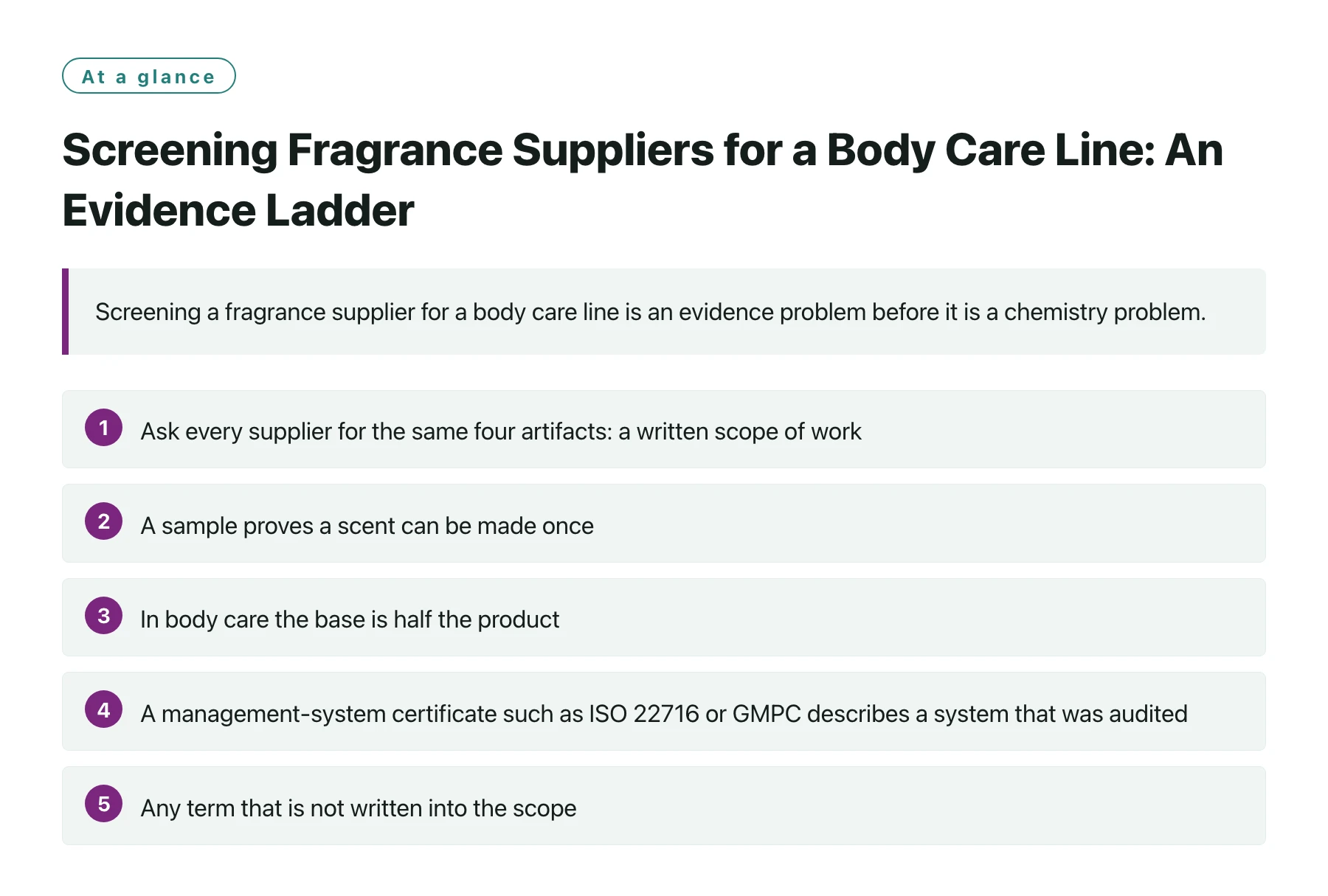
- Ask every supplier for the same four artifacts: a written scope of work, a specification sheet, a safety and compliance file, and a batch record from a comparable project.
- A sample proves a scent can be made once; a retained reference standard with its batch number and formula version proves it can be made again.
- In body care the base is half the product, so a supplier that has never stabilised a fragrance in a wash-off, an emulsion or an oil carries untested risk into your order.
- A management-system certificate such as ISO 22716 or GMPC describes a system that was audited, not what happened on your batch, so plan to review independent testing or certification evidence separately.
- Any term that is not written into the scope, including exclusivity, ownership, hold time and colour tolerance, will be decided later by whoever has the most leverage at that moment.
Most sourcing conversations start in the wrong place. The buyer sends a paragraph, three suppliers reply with a price per kilogram, and the cheapest number wins a project that was never scoped. Six weeks later the sample is fine but the bulk is slightly darker, the fill weight drifts, and nobody can say whether the difference was the formula, the base or the filling line.
Screening is the part that prevents that, and it does not require a lab or a consultant. It requires a decision about what you will accept as evidence, applied evenly to every candidate so the comparison is real rather than a contest of sales confidence.
The evidence ladder: what to request at each stage
| Stage | What you will hear | Evidence that closes the question | What the evidence still does not prove |
|---|---|---|---|
| Brief | We can make anything | A written scope naming categories, formats, fill sizes, target markets and a timeline | Whether the factory has run your format at your intended volume |
| Sampling | Here is a sample, tell us what you think | A reference standard with a batch number and the formula version it came from | That the same lab and the same materials will run your bulk |
| Costing | This is our best price | A line-item quote tied to one bill of materials that every supplier receives | Tooling, decoration, rework and testing costs that sit outside the sheet |
| Pilot | The pilot went well | A pilot batch record with weights, temperatures, QC results and yield | Whether the same operators and line settings will run the bulk order |
| Bulk | It matches the sample | Retained pilot and bulk samples compared against each other at release | Nothing further at this stage; this is the evidence that decides the outcome |
Each rung asks for an artifact rather than an assurance, which is what makes the ladder comparable across suppliers.
Why a body care line makes this harder than fine fragrance
The base is not a neutral carrier
A fragrance accord in a surfactant system, an emulsion or an oil behaves differently from the same accord in alcohol. Solubility, pH, preservative system and processing temperature all affect how the scent reads and how long it lasts on the shelf. Dosage guidance for fragrance materials is set according to product type and exposure, which is why the same concentration can be acceptable in one format and not in another [1].
A supplier that treats the base as neutral will quote confidently and discover the problem during stability testing. Ask what base the sample was built in, and whether it was the exact base you intend to sell.
Wash-off and leave-on are two different projects
A body wash and a body lotion from the same scent family are not one development task with two labels. The wash-off format tolerates a higher loading because exposure is brief and rinsed; the leave-on format is judged on skin feel, colour stability and how the scent evolves over hours. Screening questions should separate them from the first email so the sample you approve matches the product you will sell.
Format creep is the quiet cost
A range usually starts with two products and grows to six. Each new format is a compatibility question and often a new stability run. A maker such as Guangzhou Xuelei that compounds and fills under its own roof can test that question on its own line; a supplier who brokers the work will pass it back to you as a new sample fee. Neither approach is wrong, but you should know which one you are buying before you sign.
Running the screen in a single afternoon
- Write one scope sheetFormats, fill sizes, target markets, annual volume estimate, launch window and the claims you intend to make. One page, sent unchanged to every candidate.
- Send the brief and the artifact list togetherState up front that you will compare written answers, not calls. This filters out suppliers who only sell on the phone.
- Score documents, not impressionsGive each artifact a pass or nothing. A factory that answers three of four items in writing is ahead of a charming one that answers none.
- Request one comparable batch recordRedact the customer name if needed; the record still shows whether QC gates exist and who signs them off.
- Only then discuss priceBy this point you are comparing the same work, which is the only condition under which quotes mean anything.
Reading the answers you get
The strongest signal in this process is specificity. A supplier who replies with the name of the base they would use, the stability protocol they would run and the person accountable for the batch record has already told you how the order will go. A supplier whose reply is a brochure and a price has told you something too.
It also helps to look at how a maker describes its own range and history, because the same detail disappears from marketing pages that fail in technical documents. A short written guide to what to verify before signing with a fragrance manufacturer is a useful checklist to hold next to the replies. Documents themselves can be checked independently; third-party cosmetic testing and certification services exist precisely to verify the parts of a supplier claim that a buyer cannot inspect [2].
Screening does not end at the shortlist. If you are building a scent rather than buying a library item, the shortlist is where development starts, and a manufacturer that builds custom scents should be able to show the development file as it grows, not only the final formula.
If a supplier declines to share even a redacted batch record under a confidentiality agreement, treat that as an answer to your question. It is not proof of a problem, but it is proof that you cannot verify one.
Sources
- IFRA Standards Library (International Fragrance Association) —— The IFRA Standards Library lists the restrictions the fragrance industry applies to individual fragrance ingredients, based on safety assessments; it is the reference point for compliant fragrance formulation.
- SGS: Cosmetics, Personal Care & Household Testing —— Testing, inspection and certification services for cosmetics and personal care, including microbiological, stability and safety testing aligned with cosmetics GMP.
Frequently asked questions
How many fragrance suppliers should I screen for a body care line?
Three to five is usually enough to see the range of what the market will offer without turning the comparison into a full-time job. Screen them all on the same artifacts, then take at most two into sampling.
Is an approved sample enough to judge a supplier?
No. A sample shows that a scent can be produced once, under lab conditions. Ask what base it was made in, which formula version it represents, and how the factory will reproduce it at bulk scale.
Do I need a factory with ISO 22716 for body care?
A recognised cosmetics GMP certification is a reasonable baseline for a body care product sold in regulated markets, but it answers a system question, not a batch question. Collect it alongside batch records and test reports rather than instead of them.
What if the cheapest quote comes from the supplier with the thinnest documentation?
That combination is common and it is informative. Compare the quotes against the same written scope, then price the missing evidence as risk: extra testing rounds, a reworked pilot or a delayed launch usually costs more than the gap between quotes.
How do I screen suppliers that work with different fragrance houses?
Do not screen the house, screen the process. Ask who holds the formula, whether the same base and materials are used from sample to bulk, and how a change of material is communicated and re-approved before shipping.
Carry something made by a single pair of hands.
Browse the current season — fewer than 2,400 pieces are released each year, and many editions are already spoken for.
Shop the Collection